Grossschiednitz Hospital
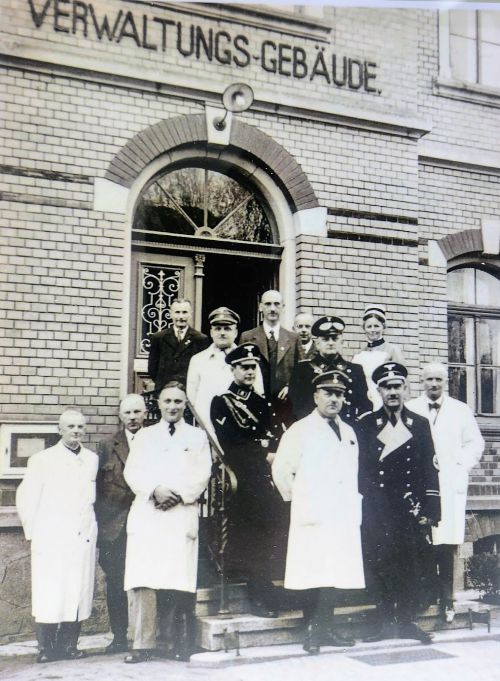
It is important to note that the hospital at Grossschiednitz was not a pure T4 Hospital but a feeder establishment. These type of units are virtually ignored in favour of the six T4 Hospitals. Patients from here were transported to the T4 institute at Pirna-Sonnenstein,
The history of psychiatry in 20th Century Germany is marked by a profound tension between therapeutic innovation and state-sponsored destruction. No institution embodied this tragic duality more clearly than the Grossschiednitz Asylum in Saxony. Founded at the dawn of the 20th century as a model of progressive humane psychiatric care, the hospital was later weaponised by the National Socialist regime. Between 1939, and 1945, its idyllic campus was transformed into a critical hub for the Aktion T4 mass murder campaign and a site of decentraised 'wild euthanasia.'
The historical trajectory of Grossscheiednitz - stretching from its enlightened beginnings through its descent into medical criminality to its post-war rehabilitation and modern commemoration - serves as an enduring case study in how medical ethics can be systematically subverted by state ideology. At its inception Grossscheidnitz Asylum represented the vanguard of European psychiatric architecture and patient care. Opened on April 1, 1902, as the Koniglich - Sachische Heil und Pflegeanstalt, the facility was designed to counteract the grim prison-like conditions of 19th century asylums.
Built in a decentralised 'villa colony' style, the complex originally distributed 524, beds across 19, distinct pavilions nestled within a park-like landscape. This architectural philosophy aimed to foster a therapeutic community, emphasising fresh air, dignity and openness. By 1912, the asylum expanded with the addition of characteristic yellow-brick buildings, increasing its capacity to accommodate a rising influx of chronically ill patients.
This progressive trajectory was disrupted by the geopolitical crises of the early 20th century. The outbreak of World War One in 1914, brought severe resource scarcity to the asylum. Trade blockades by the Allied forces and the prioritisation of the military war effort resulted in catastrophic food and medical shortages within civilian state institutions. At Grossscheidnitz patient mortality rates soared as systematic under-provisioning led to widespread starvation and disease.
Following the war, the Weimar Republic attempted to restore and reform the institution. Throughout the 1920's, Grossscheidnitz embraced reform psychiatry , implementing active occupational therapy programs designed to rehabilitate patients and re-integrate them into social and economic life.
The Nazi Party's assumption of power in 1933, dismantled the humanitarian foundations of German psychiatry, replacing therapeutic care with racial hygiene and eugenics. Following the passing of the 1933, Law for the Prevention of Hereditary Diseased Offspring , the medical staff at Grossschiednitz ceased acting as caretakers and became agents of the state performing hundreds of forced sterilisations on patients deemed 'genetically inferior.' By the late 1930's, the shift from forced sterilisation to systematic murder was underway. In 1938, the hospital began implementing targeted medical neglect, deliberately reducing patient rations and reducing basic care to accelerate the death rates of those deemed 'burdensome' to the state.
When the Second World War started Grossscheidnitz was visited by Karl Brandt, the co-head of the T4 Aktion program, and integrated into the Euthanasia program as a transit asylum facility. Over 2300, psychiatric patients from across Central Europe were funnelled through the facility, processed and loaded onto the grey buses operated by the Gemeineinnutzige Krankentransport GmbH (GEKRAT) which transported them to the nearby Pirna-Sonnenstein Euthanasia Institution, where they were murdered in custom-built gas chambers.
When public protests and religious outcry forced Adolf Hitler to officially halt the T4 euthanasia operations in August 1941, the killings did not cease, instead, they evolved. Grossscheidnitz became a primary site for decentralised or 'wild euthanasia' murders. Rather than outsourcing murder to regional gas chambers, the institution own physicians and nurses took direct responsibility for terminating life . In late 1943, a specialised children's ward, the Kinderfachtabteilung was established. Armed with lethal doses of common medications like Luminal and Morphine, combined with deliberate exposure to freezing temperatures and systematic starvation diets, the medical staff executed vulnerable people on-site. By May 1945, more than 5,500 adults and children had been brutally murdered within the confines of the asylum.
In the immediate aftermath of the Second World War, the horrors committed at Grossschiednitz were brought to light by the Soviet authorities. On January 7, 1947, the Dresden State attorney formally indicted the Director of Grossschiednitz Dr. Alfred Schultz, alongside other prominent T4 doctors, including Dr Paul Nitsche. Alfred Schultz was charged with crimes against humanity for his role as the Medical Director overseeing the mass murder of patients at the asylum. There was a public trial held between June 16-25, 1947, and before the final verdicts were handed down in December 1947, Dr Alfred Schultz died on November 1, 1947, in the prison hospital in Zwickau.
Today Grossscheidnitz site remains an active psychiatric hospital and acts as the Sachsisches Krankenhaus Grossschednitz.
© Holocaust Historical Society - Guest Article by Howard de Lestre, July 9, 2026