Walter Liska
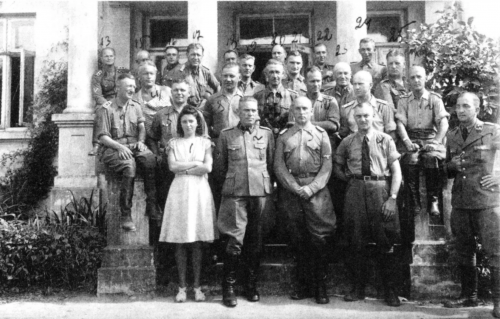
Walter Liska, front row middle in Radomsko during the Nazi Occupation
Walter Liska was born on December 11, 1899, in Berlin. After attending school and completing an apprenticeship as a Business graduate, Walter Liska joined the police force as a trainee detective during 1925. He was appointed to the post of Detective Inspector in 1927. In 1930, he was transferred to the State Criminal Police office in Koslin, and in 1931, he was posted to the Criminal and Border Police station in Lauenberg.
Walter Liska joined the Nazi Party on April 1, 1933, (Membership Number 1824, 896). In November 1934, he was appointed head of the field office at the State Police Office in Koslin, from where he was transferred on January 1, 1935, to the State Police Office in Stettin, as head of the counterintelligence department there. Later that same year, he was transferred to the Secret State Police - the Gestapo in Berlin, where he was responsible for the counterintelligence department for Italy, Hungary and Yugoslavia.
In 1936, Walter Liska joined the SS, his SS Number was 290,299. In 1939, Liska who held the rank of Criminal Councillor since 1938, was appointed head of the Southern Counterintelligence Department at the Reich Security Main Office (RSHA). However, he never took up this post, as he was deployed to Poland, at the outbreak of the Second World War.
There, he initially worked for the KdS in Krakau, and in December 1941, Liska was appointed head of Department IV, of the Commander at the KdS, in Lublin, assuming responsibility for all Gestapo activity in that district. He played an active part in the deportation of Jews from Lublin to the Belzec death camp, and the liquidation of the Lublin Ghetto. He was promoted to the rank of SS-Sturmbannfuhrer on January 30, 1943. He was posted to Radomsko, and during late August 1944, he was posted to Slovakia, where he commanded an Einsatzkommando, responsible for arresting and depprting Jews.
From 1944, Liska served as head of the Osnabruck branch of the Bremen State Police Headquarters. He spent the final months of the Second World War with the Army High Command of an SS Panzer unit. At the end of the war, Walter Liska was taken prisoner by the Allies. After his extradition to Poland during 1946, he was sentenced to death in Lublin on August 20, 1948, and he was executed by hanging on February 15, 1949.
Sources
Wikipedia
Photograph: Private Archive
Thanks to Georg Biemann
© Holocaust Historical Society November 16th, 2026