The Assassination of Franz Kutschera in Warsaw
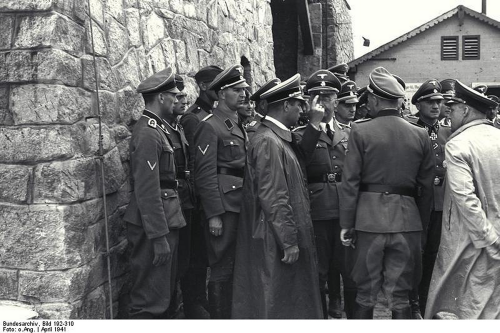
Franz Kutschera standing next to Heinrich Himmler on a tour of the Mauthausen Concentration Camp on April 1, 1941. (Bundesarchiv)
Franz Kutschera was born on February 22, 1904, in Oberwaltersdorf, Austria. He joined the Navy and served during 1918-1919. He worked as a gardener, the same profession as his father, between the wars and joined the Nazi Party on December 5, 1930. He joined the SS, on November 1, 1931, in Austria. His SS Number was 19659.
He was promoted to the rank of SS-Standartenfuhrer on July 25, 1938, and to SS-Oberfuhrer on January 30, 1939. He also held a number of Nazi Party posts and served as a Gauleiter for Carinthia during February -March 1938.
After the Anschluss, he was deputy Gauleiter for Carinthia until mid-November 1941, and was promoted to SS-Brigadefuhrer on November 9, 1940. During 1940, he served as an officer candidate in the reserves with an Army mountain regiment and also held a seat in the Reichstag from April 1938.
He was reassigned to Police duties in January 1942, and he trained with Erich von dem Bach's staff and then became SSPF Mogilew from April to September 1943, obtaining the rank of Generalmajor der Polizei on November 9, 1942..
Kutschera's whereabouts in Warsaw were a closely guarded secret, but these were discovered by Alexsander Kunicki (code named Rayski), the head of intelligence of the Agat company, while he was investigating two other potential assassination targets, Dr Ludwig Hahn, the Kommandeur of the Sicherheitspolizei und Sicherheitsdienst in occupied Warsaw and SS-Sturmbannfuhrer Walter Stamm.
In the course of his surveillance of the area around the Gestapo Headquarters on Aleja Szucha, he one day noticed an Opel Admiral limousine entering the drive of the building at Aleja Uzazdowskie number 23, which was then the SS Headquarters in Warsaw. The SS officer who emerged from the vehicle wore the insignia of a General, and Rayski began to monitor his arrivals and departures from the building. The SS-Officer was soon identified as Franz Kutschera, who actually lived only 150, meters away, at Aleja Roz number 2. Despite the short distance from his home to the SS Headquarters, Kutschera always used his car to travel there.
Rayski filed a report about Kutschera to Kedyw commander Emil August Fieldorf (code name Nil) and several days later Franz Kutschera was sentenced to death, by a 'Special Court' of the Polish Underground State. Adam Borys (code name Plug), commander of the Parasol Battalion of the Armia Krajowa, selected Parasol's 1st Platoon to carry out an assassination attempt. Platoon commander Bronislaw Pietraszewic (code name Lot) was appointed as leader of the assassination team, and he planned the operation in close contact with Plug.
The first attempt on Franz Kutschera's life was prepared for January 28, 1944, but had to be aborted after Kutschera failed to leave his home that day. After the assassination team went their separate ways, one member of the platoon, Jan Kordulski (code name Zbik) was wounded by a German patrol. He was replaced in the team by Zbigniew Gesicki (code name Juno) and Stanislaw Huskowski (code name Ali).
The second attempt took place in the morning of February 1, 1944. One of the members of the assassination team Maria Stypulkowska – Chojecka (code name Kama) at 9.09, A.M. signalled that Kutschera was leaving his house at Aleja Roz 2, in his limousine. As he approached the gate of the SS Headquarters, he was blocked by a car driven by Michal Issajewicz (code name Mis).
Bronislaw Pietraszewic (code name Lot) and Zdislaw Poradzki (code name Kruszynka) left the car and approached the limousine and opened fire on it, at close range. The driver Hans Lupatsch, was killed immediately and Franz Kutschera was badly wounded. Michal Issajewicz (code name Mis) then exited the car and finished off Kutschera with a gunshot to the head. Then they searched his body for documents.
Meanwhile, two getaway vehicles moved into position and German guards stationed nearby opened fire on the members of the resistance. An intense shootout then erupted between the Germans and the covering team. Marian Senger (code name Cichy), Henryk Humiecki (code name Olbrzyn) and Zbigniew Gesicki (code name Juno). Stanislaw Huskowski (code name Ali) at this critical moment was unable to open his briefcase, in which several hand grenades were concealed. Cichy, Lot and Olbzyn were all wounded in the firefight. Due to his injury, Lot's call to withdraw was not loud enough to be heard, and as a result the shootout was unnecessarily prolonged, but all the members of the team were able to eventually get into their cars and drive away.
A frantic search for a hospital willing to defy the Germans and operate on the heavily wounded Cichy and Lot began. It took several hours and five attempts before a hospital finally admitted them. Resulting from this delay both men died within a couple of days.
Meanwhile, Kazimierz Sott (code name Sokol) and Zbigniew Gesicki (code name Juno) were intercepted while driving across the Kierbedz Bridge. After a short exchange of fire, they both jumped into the Vistula River, where they were shot at. Later according to a Schutzpolizei report, the Germans recovered their bodies.
Sokol had been shot and had his identity card with him, which later caused German reprisals against his family. Juno had drowned, and his body was recovered, but he had no documents, and therefore could not be identified by the Germans. To further help conceal Juno's identity and his involvement in Operation Kutschera, the AK later took his railway hat and documents from his family in Piastow. They later delivered them to the Polish Police station in the suburb of Grojec. It is not known what the Germans did with their bodies.
The Germans held Franz Kutschera's funeral ceremony in the Bruhl Palace. His body was then transported to Berlin on a special train. On the next day, February 2, 1944, the German authorities shot three hundred civilian hostages in one of the last public executions in the city prior to the outbreak of the Warsaw Uprising which commenced in August 1944. The Germans also imposed a 100, million- zloty tribute on the Polish residents of Warsaw and the Warsaw District.
SOURCES: Mark C Yerger, Allgemeine-SS, Schiffer Military History, Atglen PA, 1997
www. Wikipedia, online resource
© Holocaust Historical Society January 26, 2026